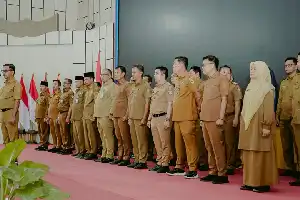
The Indonesian government has officially urged BRICS member countries to strengthen collaboration in mapping future workforce skill requirements (future skills forecasting). This strategic proposal was delivered directly by the Minister of Manpower, Yassierli, during the BRICS Labour and Employment Ministers' Meeting (LEMM) 2026 held in Hyderabad, India. This step is considered crucial to anticipate the increasingly dynamic global labor market.
Yassierli emphasized that mapping these competencies will serve as an important foundation for each country in formulating adaptive employment policies. With accurate mapping, vocational education and job training programs can be quickly aligned to respond to technological disruption, industrial transformation, demographic shifts, and the demands of the transition toward a green economy.
On this occasion, Indonesia proposed that the future skills projection initiative be integrated into the cooperation focus of the BRICS CONNECT platform. According to the Minister, this forum is a highly strategic South-South partnership (South-South cooperation) platform for sharing best practices, exchanging experiences, and generating concrete solutions for the welfare of both workers and business actors.
In addition to presenting this global proposal, Yassierli also outlined various concrete steps Indonesia is taking to strengthen its domestic labor market. These efforts include expanding access to vocational training, strengthening social security for informal workers, establishing a Layoff Task Force (Satgas PHK), and optimizing the Job Loss Guarantee Program (JKP). The government is also committed to creating more inclusive workspaces by building disability-friendly training centers equipped with assistive technology.
To support this acceleration, the government targets the National Internship Program to be joined by 150,000 participants, while the National Vocational Training Program is targeted to reach 300,000 participants throughout 2026. This synergy is also supported by national priority programs such as commodity downstreaming and the provision of an integrated labor market information system to digitally connect job seekers with industrial needs.