Residents of Pasi Birah Village, Woyla District, can now breathe a sigh of relief. The limited access to clean water in the area is starting to be resolved thanks to the implementation of a water filtration technology based on local materials developed by the academic community of Teuku Umar University (UTU). Through an empowerment program, the local community was trained to assemble and maintain the filtration system independently to meet their daily domestic needs.
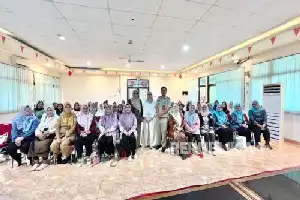
This concrete step was realized through a Technical Guidance (Bimtek) session on assembling clean water filter equipment and media, which took place at the Meunasah of Pasi Mesjid Village, Woyla. This activity is the result of a collaboration between the Student Organization Capacity Strengthening Program (PPK Ormawa) team of the Civil Engineering Student Association (HMTS) and the Research-Based Community Service (PKMBR) team of UTU.
To ensure the sustainability of the program, the SIGAP Air Working Group (Pokja) was formed, consisting of local youth and women. This group is projected to be the main driving force in managing the clean water infrastructure. The Chairperson of PPK Ormawa HMTS, Fahri Dwi Alfhi, emphasized that the readiness of human resources at the village level is crucial so that the public facilities built do not go to waste or end up abandoned.
Echoing this, the Leader of the UTU PKMBR Team, Ir. Cut Suciatina Silvia, S.T., M.T., IPM., stated that community independence is the key to the sustainability of this grant program. According to her, this education was intentionally designed to provide residents with a deep understanding so that they no longer rely on external assistance when facing technical obstacles with the water filtration system in the future.
From a technical standpoint, the filtration system designed by the UTU student team—Aldi Al-Ihsan, Ronald Wijaya, and Agung—uses a simple yet highly applicable concept. This filtering device utilizes nine layers of filtration media easily found in the surrounding environment, such as palm fiber, coral stones, zeolite sand, coconut shell charcoal, and silica sand. The combination of these materials has proven effective in clarifying water, as well as removing odor and turbidity from the local raw water.
During the training, residents seemed enthusiastic about directly practicing the arrangement of the filter media and conducting water flow tests. Armed with a practical guide module distributed by the UTU team, the SIGAP Air Working Group now has the full capacity to operate and perform periodic maintenance independently to guarantee a sustainable clean water supply for their village.