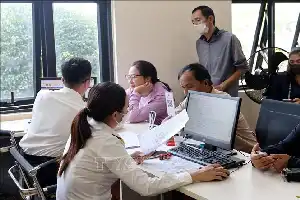
The School of Business and Management at Institut Teknologi Bandung (SBM ITB) officially introduced the Sustainable Business Institute during a media briefing held at the MBA ITB Building, Bandung, on Monday (6/7/2026). This initiative marks a strategic step for the institution to expand its tangible contribution to society, business, and the government by strengthening the sustainable development agenda.
Dean of SBM ITB, Prof. Dr. Aurik Gustomo, S.T., M.T., emphasized that this move aligns with SBM ITB's ambition to reinforce its international academic environment. Having earned AACSB international accreditation and backed by faculty members from various countries, SBM ITB is now aiming for a significant increase in international students as proof of global recognition of the educational quality it offers.
Through this new institute, SBM ITB is committed to transforming the three pillars of higher education (tridharma) into practical solutions for real-world issues. One concrete example is the mentoring of MSMEs in the Cirata Solar Power Plant area, designed to support the achievement of SDG 8 on decent work and economic growth. In addition, various other empowerment programs, such as ecotourism in Garut and economic revitalization in Cihapit Market, serve as concrete proof of faculty and student involvement in the community ecosystem.
On the same occasion, Dedy Sushandoyo, Ph.D., highlighted that SBM ITB's main strength lies in its entrepreneurial business culture based on bold and innovative research. This approach was reinforced by Anggara Wisesa, who stressed the importance of measurable social impact. According to him, SBM ITB's contribution is no longer partial, but integrated bottom-up to address challenges in governance, market access, and the digitalization of local businesses.
The Sustainable Business Institute now umbrellas various initiative projects such as The Greater Hub, Teras Hijau Project, and the Social Forestry program. Through cross-sector synergy and international collaboration, SBM ITB positions itself not only as an educational institution, but also as a socio-economic change catalyst adaptive to global dynamics and local community needs.