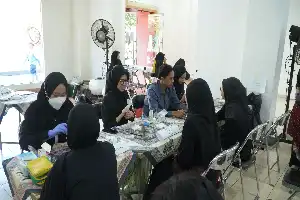
Food waste management is no longer focused solely on environmental sustainability, but has also transformed into a strategy to increase business efficiency. Recognizing this, the Indonesia Business Council for Sustainable Development (IBCSD), in collaboration with the West Java Provincial Government, organized a food waste management training for the hotel, restaurant, cafe (HOREKA), retail, and bakery sectors.
The training, which took place last weekend, is a concrete implementation of cooperation in low-carbon development and circular economy in West Java. This strategic step is under the umbrella of the GRASP 2030 (Mutual Cooperation to Overcome Food Loss and Waste) movement, an initiative launched by IBCSD to support sustainable food security.
The Executive Director of IBCSD, Dr. Indah Budiani, explained that every unsold or wasted food item carries significant financial loss consequences for businesses. According to her, food waste represents a waste of investment in raw materials, labor, energy, water, storage processes, and even the cost of waste disposal itself.
The urgency of this step is reinforced by the 2024 National Waste Management Information System (SIPSN) data from the West Java Environmental Office. The data shows that food waste dominates waste accumulation in the West Java region, contributing up to 39.02 percent of the total volume of waste generated.
Based on an initial poll conducted by IBCSD among participants, as many as 53 percent of business owners claim to have adopted food waste reduction policies, and another 30 percent are designing similar programs. However, limited resources and the lack of a uniform measurement system remain key obstacles for the industry today.
The Head of the Economy and Natural Resources Division of Bappeda West Java, Eka Jatnika Sundana, emphasized the importance of cross-sector synergy in changing production and consumption patterns from upstream. On the other hand, the Director of Food Alertness of the National Food Agency, Nita Yulianis, suggested a redistribution or donation scheme for edible food to help vulnerable communities while suppressing waste generation.
The Assistant Deputy for Sustainable Tourism Business Management of the Ministry of Tourism, Amnu Fuady, added that investing in food waste reduction is highly profitable. Referring to a global study in the hospitality sector, every 1 USD spent on this program has the potential to save an average of up to 7 USD in operating costs. To facilitate practical steps, business operators are now being equipped with the 'Stop Boros Pangan' (Stop Food Waste) application and the Target-Measure-Act (TMA) method in their operational activities.