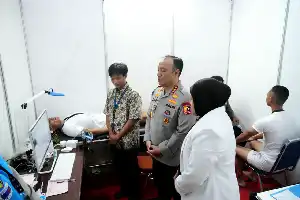
HIV/AIDS cases in Madiun Regency are still considered to resemble an iceberg phenomenon, where the actual figures on the ground are believed to be much higher than the recorded data. The Madiun Regency Regional AIDS Commission (KPAD) recorded that the cumulative total of assisted individuals up to July 2026 had reached 1,648 cases, consisting of 1,354 HIV cases and 294 AIDS cases.
Of this cumulative total, 888 patients are reported to be surviving, while 760 others have died. Throughout 2025, 193 new cases were detected, while for the period from January to July 2026, KPAD found 130 new cases. This increase in numbers aligns with the intensive screening and field outreach efforts.
Lenny Dwi Ambarsari, the Daily Program and Finance Manager of Madiun Regency KPAD, explained that current findings are only a small fraction of the actual reality. According to her, there are still many infected individuals who have not been recorded and have the potential to transmit the virus because they have not received proper medical assistance.
Although Jiwan District still holds the top cumulative position with 198 cases, KPAD has detected a shift in new distribution areas. The trend of annual case findings is now starting to be dominated by the districts of Saradan (179 cases), Pilangkenceng (152 cases), and Kare, surpassing historical data in Jiwan.
From the risk factor perspective, heterosexual intercourse is the most dominant route of transmission with a percentage reaching 46.97 percent, equivalent to 774 cases. Meanwhile, when viewed by community groups, the Men who have Sex with Men (MSM) group recorded the highest number of cases in this region.
To curb the transmission rate, Madiun Regency KPAD relies on Mobile Voluntary Counseling and Testing (Mobile VCT) services conducted periodically every three months targeting high-risk groups. KPAD is also expanding the referral network for Antiretroviral (ARV) therapy to hospitals outside the region to facilitate patients with high mobility.
Lenny emphasized that tackling HIV/AIDS does not only focus on the medical realm, but also touches on social, economic, and administrative registration aspects of the patients. She encouraged the strengthening of cross-sector collaboration down to the village level to succeed in the Ending AIDS 2030 target, under the principle of embracing the patients and staying away from the disease.