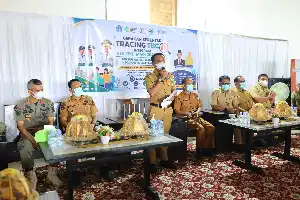
The Regional Disaster Management Agency (BPBD) of Sleman Regency has taken a progressive step in strengthening regional preparedness on the slopes of Mount Merapi. Through a Public Consultation Forum held in the Op Room Meeting Room of the Kalurahan Community Empowerment Office on Monday (13/7/2026), the agency began drafting a new disaster service standard for 2026.
This strategic move is a form of compliance with the mandate of Law No. 25 of 2009 on Public Services and Law No. 14 of 2008 on Public Information Openness. To produce a comprehensive management system, BPBD Sleman is involving various cross-sectoral elements, ranging from academics, business actors, journalists, and humanitarian organizations to local volunteer communities.
The Chief Executive of BPBD Sleman, Bambang Kuntoro, emphasized that drafting this service standard is not merely an administrative obligation. He stressed the importance of public evaluation and input so that the resulting service instruments are truly applicable, transparent, accountable, and easily accessible to all levels of the community affected by disasters.
Based on Public Satisfaction Survey data, the public satisfaction index for BPBD Sleman has continued to rise, from 84.84 in 2023 to 86.22 in 2025. To maintain this positive trend in 2026, BPBD Sleman is updating regulations, streamlining bureaucracy, and adding new facilities, such as optimizing public information posts and disaster internship services.
During the focus group discussion, several critical inputs emerged. A representative from Universitas Gadjah Mada (UGM), Dewi Nurwanti, urged for certainty regarding response times in emergency situations, to be communicated directly to residents via digital communication channels. Meanwhile, Indra Baskoro Adi from UPN Veteran Yogyakarta proposed standardizing the bureaucracy to facilitate disaster research for university students.
Field operational aspects were also a serious concern. The Chairman of the Sleman Volunteer Community Communication Forum, Yoga Nugroho Utomo, highlighted the importance of official registration for volunteer groups to avoid potential illegal fees, while also requesting standardization of the early warning system (EWS) siren frequency sounds so they do not trigger public panic outside of actual emergencies.
Responding to all of these aspirations, Bambang Kuntoro committed to integrating the received recommendations into the final document of the 2026 BPBD Sleman Service Standards. This collective effort is expected to foster a disaster management ecosystem that is more inclusive, resilient, and responsive in Sleman.