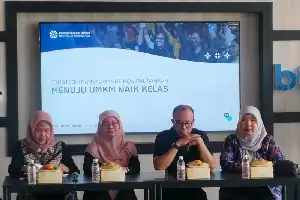
The Executive Board of the Indonesian Ulema Council (MUI) of North Sumatra, through its Ummah Economic Empowerment Institute, recently hosted a strategic Focus Group Discussion (FGD) titled "Sustainable Pesantren Business Development Model." The meeting, held at the Bank Syariah Indonesia (BSI) Region II Auditorium in Medan, aimed to formulate a roadmap for Islamic boarding schools (pesantrens) to achieve stronger and more professional economic independence.
The event brought together various stakeholders, ranging from pesantren leaders, business practitioners, and Bank Indonesia to Islamic banking institutions. This collaboration is expected to transform the vast potential of pesantrens—such as land assets and human resources—into real economic strength capable of competing effectively in the modern market.
General Chairman of MUI North Sumatra, Dr. H. Maratua Simanjuntak, emphasized the importance of digital transformation for business units within pesantrens. According to him, adopting non-cash payment systems and digital platforms is no longer just an option, but a necessity to enhance transparency and operational efficiency in pesantren-owned businesses.
Echoing this sentiment, business practitioner Bobby Umroh, Ph.D., highlighted that pesantrens possess a highly loyal internal market base. He stressed that the key to business sustainability lies in the effective use of technology to manage production and marketing, ensuring that produced goods not only meet students' (santri) needs but can also be absorbed by the broader market.
Meanwhile, circular economy development initiatives also emerged as a future model. Head of Darul Ilmi Murni Pesantren, Dr. H. Dedi Masri, proposed utilizing pesantren environmental waste for productive sectors, such as livestock farming, whose yields can directly benefit santri consumption. This innovation is expected to spark the establishment of partnership networks among pesantrens in North Sumatra on both national and international scales.