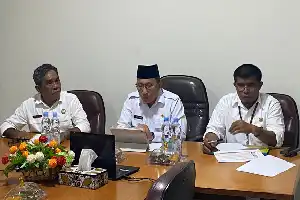
The North Kolaka Regency Government is committed to strengthening the governance of the health sector by improving the referral system, expanding the coverage of BPJS Kesehatan membership, and addressing the unequal distribution of medical personnel. This strategic step was formulated in the BPJS Kesehatan Partnership Forum, which was attended by OPD (Regional Government Agencies) officials, the Regional Legislative Council (DPRD), and representatives from the BPJS Kesehatan Kendari Branch.
Regional Secretary of North Kolaka, Muhammad Idrus, highlighted the uneven placement of doctors, particularly dentists, in remote areas such as Tolala, Porehu, and Tiwu. As a short-term solution, the local government has instructed the Health Agency and BKPSDM (Regional Personnel and Human Resources Development Agency) to implement a periodic rotation system for medical personnel to ensure that all citizens receive equal service rights.
For the long term, the North Kolaka Regency Government is designing a specialist doctor education scholarship program under a cost-sharing scheme to be included in the 2027 RKPD (Regional Government Work Plan). This program aims to recruit local youth to pursue strategic medical specialization education, such as cardiology, with a commitment to return and serve in their hometowns after graduation.
On the other hand, the data validation process for BPJS Contribution Assistance Recipients (PBI) is also a focus of improvement. The Regional Secretary urged the Social Agency and village operators to optimize the SIKS-NG application to filter data periodically so that government health insurance contribution assistance is on target and not wasted on data of deceased citizens or those who have relocated.
Meanwhile, Member of the North Kolaka DPRD, Abu Muslim, emphasized the importance of administrative service reform in hospitals. He stressed that health facilities must prioritize emergency medical treatment for patients without bureaucratic obstacles, and eliminate the stigma of difference in service quality between general patients and BPJS Kesehatan users.
Head of the BPJS Kesehatan Kendari Branch, Hernawan Priyastomo, explained that the active participation rate of JKN (National Health Insurance) in North Kolaka has now reached 84 percent, with a health service claim ratio touching 154 percent. Although local claim costs exceed the collected premiums, funding remains normal thanks to the national mutual cooperation (gotong royong) principle; however, the utilization of digital services such as the Mobile JKN application, which is only at 4 percent, needs to be continuously boosted.