The Government of Bone Regency, South Sulawesi, has begun implementing a technology-based modern agricultural system, the Advanced Agricultural System (PM-AAS), to boost rice productivity. This step is part of the acceleration of national food self-sufficiency, pioneered by the Agricultural Extension Working Team together with the Functional Job Group of Bone Regency.
Adopting agricultural patterns from Arkansas, United States, PM-AAS combines the Direct Seeded Rice (Tabela) method with high population density. The entire cultivation cycle is supported by the mechanization of state-of-the-art agricultural machinery (alsintan), such as automatic seed spreaders, agricultural drones for fertilizing and pesticides, rice transplanters, to the use of combine harvesters when harvest time arrives.
The main concept of this innovation lies in land optimization by significantly increasing the number of rice hills per hectare compared to conventional methods. In addition to mechanization, water use efficiency is also applied through the Alternate Wetting and Drying (AWD) or intermittent irrigation method, which has been proven to save irrigation water without disrupting the crop growth phase.
Through the implementation of this system, grain productivity is projected to soar to between 8 and 10.5 tons per hectare, far exceeding the national average of around 5.2 tons. Farmers are also recommended to apply specific technical standards, such as using a minimum of 70 kilograms of seed and 1 ton of organic fertilizer per hectare, to achieve optimal harvest yields.
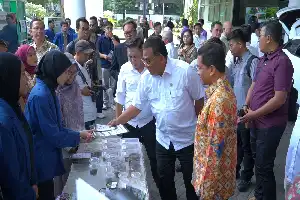
The initial implementation of this program was marked by the Simultaneous Planting Movement in Welado Village, Ajangale District, led directly by the Regent of Bone, H. Andi Asman Sulaiman. This activity was also followed virtually by farmers in nine other districts, reinforcing the region's commitment to strengthening its position as one of the national's main food barns.