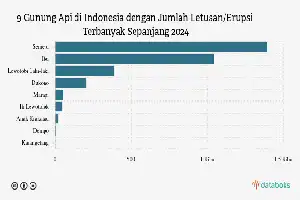
Volcanic activity at Mount Semeru, which has continued to show an increase since June 20, 2026, keeps the alert status of the highest mountain on Java Island at Level III (Alert). Although relevant authorities have issued warnings, community activities, including sand mining along lahar flow paths, are reportedly still ongoing.
Gadjah Mada University Geography lecturer Indranova Suhendro emphasized that the danger of Mount Semeru is not limited to the ejection of material during eruptions. The threat of lahar floods is actually the most significant risk due to the abundance of loose volcanic material—such as sand, gravel, and large boulders—accumulated on the mountain's slopes, which can be swept away by water flow at any time when rain falls at the summit.
"Lahars often occur suddenly without any rain in downstream areas. If heavy rain falls at the summit, volcanic material will be pushed and flow rapidly through rivers originating from Semeru, especially in the Besuksemut area, which serves as a pathway for pyroclastic flows and lahars," explained Indranova.
Regarding the presence of sand miners in the danger zone, Indranova acknowledged the dilemma between the community's economic needs and life safety aspects. Although scientifically such activities are strictly prohibited, he suggested that policymakers focus more on applying strict occupational safety standards for workers in the field.
Furthermore, Indranova analyzed the unique characteristics of Semeru's magma, which has a crystal content of up to 50 percent. This high level of viscosity forms an unstable lava dome, making it vulnerable to collapses or collapse. These collapses then trigger pyroclastic flows or hot clouds of avalanches, a phenomenon that previously reached distances of up to 16 kilometers in December 2021.
In addition to magmatic activity, heavy rainfall is also a primary trigger for lava dome collapses that spark pyroclastic flows. Given that Mount Semeru frequently experiences intense Vulcanian-type eruptions, the public is urged not to ignore instructions from the Center for Volcanology and Geological Hazard Mitigation (PVMBG) to minimize the risk of casualties.