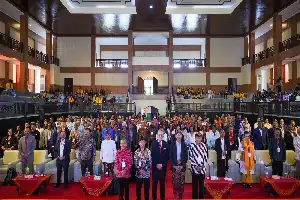
The Higher Education Association of the Regional Board of Nahdlatul Ulama (LPTNU) DKI Jakarta initiated the "Nahdlatul ‘Ilmi" movement as a strategic step to accelerate the mastery of science, technology, engineering, and mathematics (STEM) among the Nahdliyin (NU members). This step was realized through the 2026 NU Higher Education Symposium held at Roemah Djan, Menteng, Central Jakarta, on Saturday (25/7/2026).
This forum did not only formulate strategies for strengthening intellectual capacity, but also explored the establishment of a specialized higher education institution for science and technology in Jakarta. This effort is considered crucial to respond to modern-era challenges that heavily rely on artificial intelligence, digitalization, health technology, and renewable energy.
The Chairman of LPTNU DKI Jakarta, Mulyadin Permana, emphasized that the advancement of NU's human resources in the STEM sector directly reflects the acceleration of national technology. He highlighted the importance of consolidating individual initiatives from the NU community into structured and integrated institutional programs from the madrasah (Islamic school) to the higher education level.
To realize a comprehensive research education ecosystem, LPTNU DKI Jakarta is encouraging close collaboration between Nahdlatul Ulama, relevant ministries, the National Research and Innovation Agency (BRIN), and the industrial sector. Support from the DKI Jakarta Provincial Government in providing land for the science and technology campus is also expected to accelerate innovation for urban communities.
Meanwhile, the Chairman of PBNU for Education, Dr. KH. Ahmad Suaedy, called for repositioning Ahlussunnah wal Jamaah (Aswaja) as a foundation for science and civilization. The "Aswaja turn" concept was proposed to reunite classical Islamic intellectual traditions, which highly value scientific observation and technological development, for the public good.
From a macro policy perspective, the Expert Staff of the Ministry of Higher Education, Science, and Technology of the Republic of Indonesia, Dr. Muhammad Hasan Chabibie, reminded of the importance of shifting the focus of NU campus governance. Instead of being preoccupied with administrative issues and basic financing, it is now time for NU higher education institutions to gradually transform toward strengthening research capacity and sustainable downstream innovation.