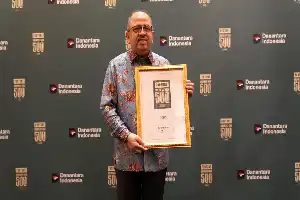
YOGYAKARTA - To address the complex challenges of student admission management, Dr. Kholid Haryono, S.T., M.Kom., has launched an innovation in the form of a Business Intelligence (BI) artifact. This decision-support system is specifically designed to make it easier for higher education management to make admission policies quickly, accurately, and based on scientific data.
This applied research was presented during his doctoral dissertation defense at the Doctoral Program in Industrial Engineering, Faculty of Industrial Technology (FTI), Universitas Islam Indonesia (UII). Through an Action Design Research (ADR) approach, Kholid did not merely create a system in a laboratory, but rather an operational platform tested directly within higher education institutions.
In its development process, this research integrates Bounded Rationality Theory and Stakeholder Salience Theory. The combination of these theories successfully maps 21 types of admission decisions and four decision-making models frequently faced by campus policymakers, including heuristic, collaborative, analytical, and intuitive models.
The system went through four developmental iteration phases: Alpha, Beta, Gamma, and Delta. The final evaluation using the System Usability Scale (SUS) showed a user satisfaction score of 84.4 out of 100. This score categorizes the system as 'excellent' and highly ready for implementation.
More than just a practical application, this research formulates 12 design principles (Design Principles) for the future development of similar information systems. This formula includes aspects of data validity assurance, decision-based information structuring, policy governance transparency, and continuous evaluation mechanisms.
Despite its significant potential to shift the decision-making paradigm from conventional intuitive methods to trusted data-driven ones, Kholid emphasized the importance of further research. He suggested cross-institutional trials to validate the effectiveness of these design principles more broadly and the development of predictive features in the future.