The date of July 31 holds an important collective memory for the course of global civilization. Two monumental events that occurred on this date illustrate the dynamics of human relations with the natural world as well as efforts to achieve peace through diplomacy in the Southeast Asian region.
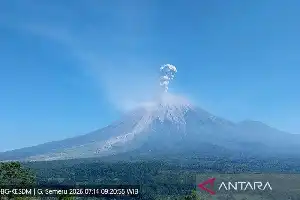
The first event takes us to the ancient geological records of Japan. On July 31, 781 BC, Mount Fuji recorded its first historically documented eruption. The first eruption of Japan's highest peak reportedly triggered a devastating earthquake of magnitude 8 to 9, which devastated the surrounding area and marked the beginning of an active volcanic phase for subsequent centuries.
Since that first eruption, Mount Fuji has experienced over a dozen powerful eruptions, including the Hoei Eruption in 1707 which spread volcanic ash as far as Tokyo (formerly Edo). Although now dormant and closely monitored by scientists, the 3,776-meter-high mountain has transformed into a global tourism icon and a sacred spiritual symbol, and has been recognized as a UNESCO World Heritage Site since 2013.
Turning to the geopolitical stage of Southeast Asia, the date of July 31, 1963, became an important diplomatic milestone. In Manila, Philippines, three leaders of kindred nations—Indonesian President Sukarno, Prime Minister of the Federation of Malaya Tunku Abdul Rahman, and Philippine President Diosdado Macapagal—signed a historic agreement known as the Manila Accord.
This accord was formulated to ease tensions related to the planned formation of the Federation of Malaysia. Through the agreement, Indonesia and the Philippines pushed for the political self-determination of the people of Sabah and Sarawak to be carried out democratically under the principles of the United Nations (UN). This initiative also gave birth to the idea of a non-political regional confederation called Maphilindo.
Through this flashback of July 31, the world is reminded of two sides of life. The eruption of Mount Fuji reflects the devastating and unpredictable power of nature, while the Manila Accord proves that international dialogue is a crucial instrument in weaving stability and defusing geopolitical conflicts.