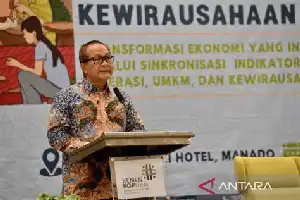
Facing increasingly selective economic challenges, the business world is required to shift from merely chasing sales volume to achieving quality corporate growth. Chief Economist of PT Bank Permata Tbk., Josua Pardede, emphasized that companies relying solely on sales expansion without the support of a solid financial foundation face a high risk of operational failure.
According to Josua, sustainable business growth in 2025 and beyond depends on five vital elements: repetitive market demand, maintained profit margins, healthy cash flow, credible corporate governance, and adaptive innovation capacity. In a domestic market environment that increasingly demands caution, the winner will not be the fastest-growing entity, but the most efficient company with a high level of market trust.
Analysis shows that essential sectors such as healthcare, logistics, basic needs, and prudent financial services are the most resilient in facing pressures on middle-class purchasing power. Conversely, companies overly reliant on commodity exports or durable consumer goods now face major challenges following trade balance deficits and input cost volatility globally.
In addition to operational resilience, good corporate governance is now viewed as a strategic instrument to reduce the cost of capital. Transparency and financial discipline have become absolute prerequisites for creditors to extend trust amid challenging economic conditions. Digital innovation was also stressed as a necessity, not just a complement, encompassing business process transformation and cybersecurity for more data-driven decision-making.
In closing, Josua advised business players to avoid price wars and focus more on market diversification as well as hedging against exchange rate risks. A conservative strategy in debt management and supply chain optimization is considered key for corporations to remain relevant and competitive in the future.