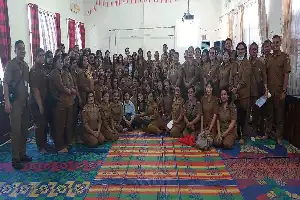
Deputy Chief of the Indonesian National Police (Wakapolri), Police Commissioner General Prof. Dr. Dedi Prasetyo, directly supervised the Specialist Health Examination (Rikkes) process for prospective male and female cadets of the Police Academy (Akpol) for the 2026 Fiscal Year. The activity, held at the Akpol Multipurpose Building in Semarang, aims to strengthen the integrity of the recruitment system through a scientific approach or scientific policing.
During the inspection, the Deputy Chief of Police was accompanied by high-ranking officers of the Indonesian National Police (Polri), including the Head of the Polri Education and Training Institute and the Governor of Akpol. A total of 409 candidates underwent a series of comprehensive health examinations across 12 specialist stations designed to measure physical condition and endurance in depth.
A crucial point in this year's selection process is the application of cutting-edge medical technology. Polri is currently utilizing Heart Rate Variability (HRV) equipment to analyze heart rhythm and endurance, as well as digital-based Bone Mineral Density (BMD) tools for early detection of musculoskeletal injury risks. This innovation is integrated with VO₂ Max testing to ensure every prospective cadet possesses optimal aerobic capacity.
The Deputy Chief of Police emphasized that modernizing these medical instruments is a strategic investment in recruiting superior human resources. The use of evidence-based technology is expected to minimize subjectivity in assessments so that the selection results truly reflect the candidates' prime physical health needed to handle the dynamic duties of policing.
Beyond technological aspects, strict adherence to medical procedures was also highlighted. The Deputy Chief of Police instructed careful screening of congenital health histories and regular evaluation procedures for prospective female cadets. This commitment aligns with Polri's efforts to implement a Clean, Transparent, Accountable, and Humanist (BETAH) recruitment process to produce resilient and adaptive future officers.